

Context
I started We Three as a challenge to myself, I sought to make a game that would push me to develop stronger programming and writing skills. Indeed, this ambitious project has shown me my limits and continues to help me push past them in ways that I am very proud of.
My Work On The Game
Designed initial game concept and core gameplay loop.
Created necessary documentation (GDD, NDD, Flowcharts).
Lead and directed the work of the team.
Programmed all core mechanics.
Set up behavior trees for both party member and enemy AI.
Created narrative concept and characters, wrote scripts for levels and "camp scenes".
For a detailed breakdown of my work, continue below!
Part 1: Pre-Production & Planning
We Three started as a personal project meant to showcase my talents, and push them further than I had before. To that end, I designed the game to challenge me on three core aspects:
Game Design: I wanted to create a game that was much more mechanically complex than what I had done before, closer to the RPG games I enjoy.
Narrative Design: None of my previous projects had implemented their narratives in ways that I found satisfying, nor was I the one to write the scripts. These are both things I wanted to learn and improve at in We Three.
Programming & AI: Despite being the programmer on previous projects, I felt that up to this point I was only scratching the surface of UE5 Blueprints, especially when it came to creating AI.
This culminated with a fantasy Real Time With Pause (RTWP) action-narrative game. The goal is to deliver the same party management and strategic gameplay an older RPG might deliver while still being an action game, and utilizing the environment to add unique and diverse encounters.
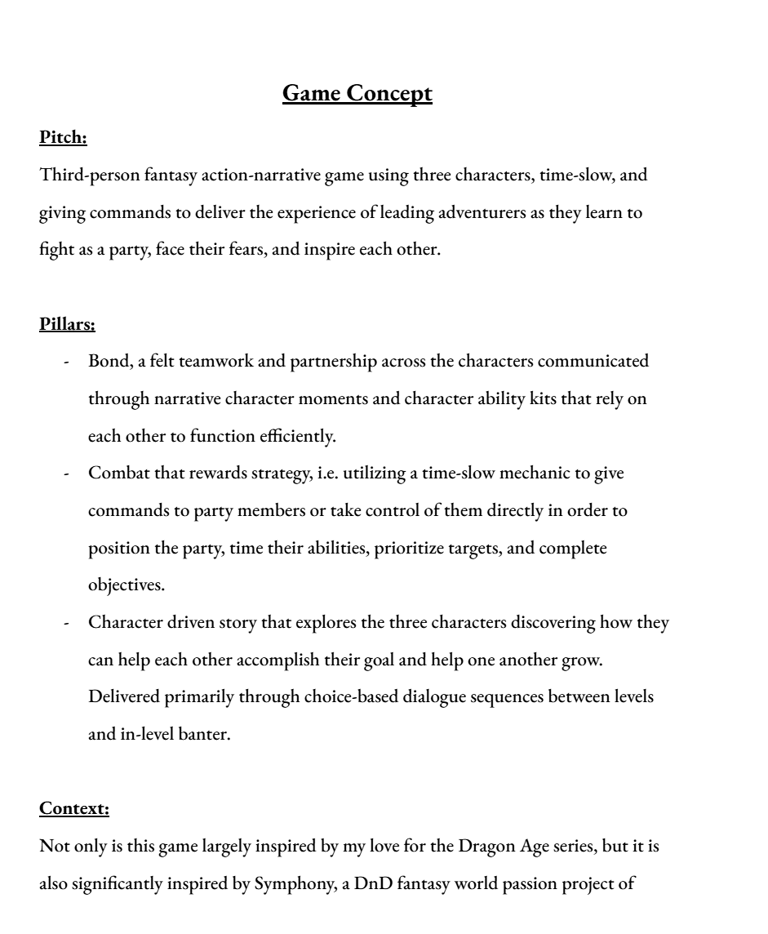
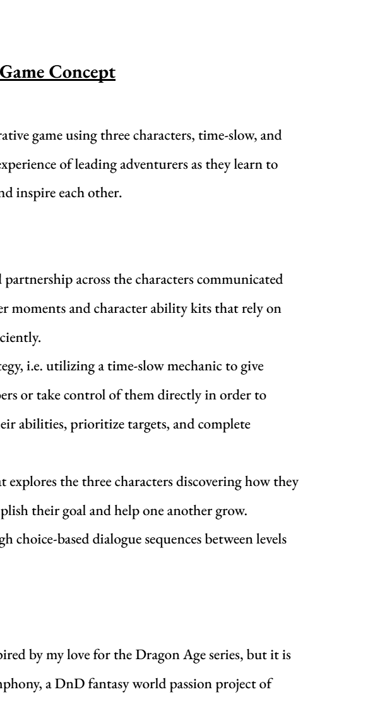
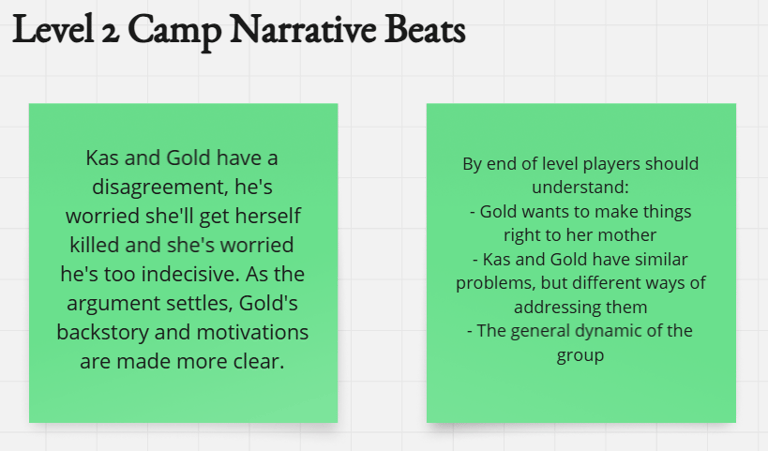


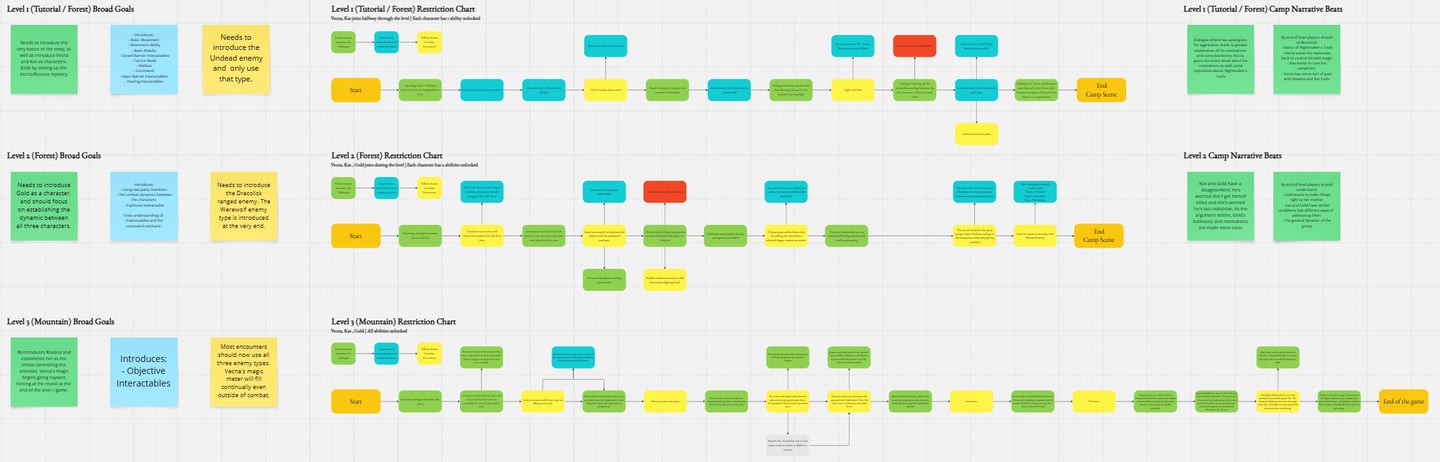
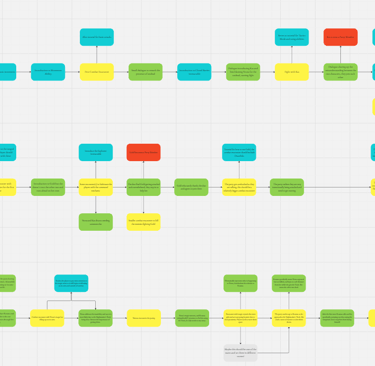
In order to properly introduce the game's mechanics and deliver a satisfying narrative, I wanted to make sure that the pacing of the game was thoroughly planned. My primary solution to this was creating "Restriction Charts": graphs that show the bare minimum of what needs to happen / what the player needs to learn in each level of the game, and in what order.
This allowed me to get a good idea of the full scope of the game very early in production, and make cuts accordingly. The game originally had four levels planned, but after showing the charts to the team, it was pointed out that the game could fit into a leaner three levels instead.
Once in-engine development began, level designers would first refer to these to know what mechanics are used, what their level must accomplish, and the when / where narrative beats would be placed within them. Most anything else about the level was left to their own creativity.
(Click on pictures to expand)
Part 2: In-Engine Production
We Three has had, so far, approximately 3 months of in engine development. I have spent the majority of this time working with UE5 Blueprints: implementing the core mechanics, creating AI behaviour trees, and bug fixing. Here is some of the most significant work I have accomplished in these aspects:
The Party & Tactics Mode
The Camp

Interactables
My goal with We Three's core gameplay loop is to merge party based tactical gameplay with third person action oriented combat. To this end, players can open Tactics Mode at almost any time, slowing down time, and allowing them to give quick orders to party members. These orders can be to attack specific enemies, use an ability, or use an Interactable in the environment. The idea here is for players to be able to slow down the situation, assess, and plan quickly, but never allowing them to fully pause the action. Ideally, this keeps up a momentum and pressure a mechanic such as this could potentially take away.
In team based multiplayer games such as Overwatch, much of the excitement and teamwork comes from working together to accomplish an objective, often tied to the environment (i.e. a capture point, or payload). I wanted to bring a similar feeling into We Three to capitalize on the feeling of working as a team with the party members. To do so, the game includes objects in the environment that have to be interacted with and/or "completed" in order to progress the encounter. This adds to the tactical depth, as players have to balance when to accomplish these objectives, who does so, and protect them.
In between levels, the characters make camp for the night, a great opportunity to slow the pace of the game and insert narrative beats. When the camp scene opens, dialogue focused on moving the story forward begins, keeping light on details and staying short. If players are interested in learning more or interacting with the characters further however they may start optional conversations with a character based on a selection of topics. The camp updates dynamically as the game progresses, with new topics and characters.